Skip to content

(a part 2) a quick treatise on “cancel culture”

an incomplete part 2 – following the same thought path as on banning things.

Today I read this quote from an article by Nina Power:

first, the simple fact of the material power of platforms to remove whatever book, film, image or piece of music is deemed ‘problematic’ at any time; second, the idea that there is a ‘correct’ way to read the cultural products that we are permitted to access; and, third, that the consumers of culture cannot be trusted to think for themselves, but must be told or shown how to understand images, words and sounds.

As Nina puts it, these three traits of no-platforming represent: controlling access, controlling reception, controlling minds.

The more time I spend watching other people get annoyed – scrolling through my twitter feed, reading long threads of replies, watching people get mad and mad back, consuming the content of drama and conflict and backstabbing and who-said-what masked in the virtuosity language of justice – the more I start to hate the whole thing.

People want power.  We have to admit this.  There is power to having your voice heard, which is why de-platforming is actually an effective tactic for shutting down a person and their ideas.  It can and does work.  That doesn’t make it right.

When we lean into techniques of authoritarianism is the name of anti-authoritarianism, we cannot just shed that cloak when all of the TERFs and nazis have been “vanquished” and now we get to have our real society.  We can’t ignore that.  Creating culture is creating culture, and the one we’re creating is a morally imperative authoritarian one.  We can change the world without taking power.

Why do people revel in cancel culture?  Why has it taken our modern digital world by storm to such a degree?

Moral superiority.

Schadenfreude.

But also that genuine feeling of seeing things going to shit all around you and wanting to cling on to some semblance of moral righteousness and finding a gospel to follow in times of strife.  Cancel culture may be about social capital and performative wokeness, but why do people latch onto performing wokeness?  Because we’re becoming increasingly disconnected, people are deemed toxic and dropped off, and people want to create a community that really truly seems to embrace values, and equality, and openness, and want to build that better future they’re imagining.

It’s not right to critique the people.  Or the culture.  Let’s examine the ways in which our ever-deepening political divide and ever-increasing human hopelessness drives reasonable people to cancel culture, or to QAnon, whatever’s closer.  And no, I’m not saying that the people who are neither are correct, either.  They’re just missing the train on its way to the new future.  No one’s correct here.


i’m a dyke

pissed enough about this that i’ll rant here instead of twitter

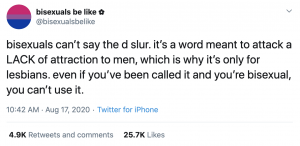
twitter screenshot reading: "bisexuals can’t say the d slur. it’s a word meant to attack a LACK of attraction to men, which is why it’s only for lesbians. even if you’ve been called it and you’re bisexual, you can’t use it."

People’s replies to this in support are mostly:

“When a bi woman gets called a dyke it’s a misdirected slur, the person using the word is trying to oppress you because they think you’re a lesbian”

and

“why do y’all bisexuals wanna use a slur so badly anyways”


The first point is laughable.  The initial tweet’s claim is absurd.  Attacking LACK of attraction to men, not attraction to women?  What the hell?  Oh, are asexual women called dykes?  Someone’s out in the streets not making out with a man, they get called a dyke? No??? You get called a dyke when you’re in the streets making out with a woman.

Also, misdirected slur? What the hell? When i’m kissing a girlfriend and get called a dyke, if I were to go “oh no good sir you have it wrong, I am actually bisexual” you really think they’ll be like “oh i’m so sorry for mis-slurring you, I’ll go find a real lesbian to oppress, please have a nice day”

No, you dense motherfucker.  People are getting called dykes for acting like a goddamn dyke.  That is, showing affection to, kissing, loving, fucking women when you’re a woman.  Loving women is great.  Getting called a dyke for doing so – you’re telling me that’s a valid experience for bi women?


Second, “why you wanna use a slur so bad”.

Come. Off. It.  Tumblr culture ruined a generation of queers by convincing them to mask the “q slur” and go on about it offensiveness.

People want to use a word that has been leveraged as a slur because the word itself is empowering and hard-hitting.  It’s like women who like to say “cunt” to refer to their vagina.  Good word.  Hard-hitting, powerful, represents my genitals.  Good.

Just like dyke.  I just bought a motorcycle, and ever since my first Pride parade I’ve dreamed of being part of dykes on bikes.  Because hard-hitting, empowering, group of women who are fucking owning their identity.

“why you wanna use a slur so bad” is so fucking dismissive, like “why you wanna label any identity at all so bad” – it gives some goddamn power to you.


Anyways, I’m so fucking over the stratifications.  Queer and dyke are rallying words for this community.  People don’t get to tell you want to call yourself, sorry, I’m over it.

In before someone’s like “oh so you don’t mind if a straight guy calls himself a dyke?” it’s like… he’s claiming for himself a label that represents a queer woman.  So like, no?  It probably means he’s not actually straight, or a guy.  People who make these dumb “false claim” arguments are the same as Republicans being like “but if we let trans people in bathrooms, any rando guy is going to claim to be trans to get into the woman’s room!”

People who hate trans people, or women, or queer people – these are not the people who take on these labels.

The people who do are vulnerable people looking for community.

Stripping that from them is cruel.

I’m a dyke and it’s not because I “want a slur” it’s because I want to build a home for myself.  The community who claims to live there with me… how dare they be the ones to rip the walls down?


The queer community has built itself on this power and solidarity.  The over-use of labels on gate-kept labels on gate-kept labels make certain that while we’re making sure no one is excluded, everyone is.  People need to get their heads out of their asses, off the internet, and show up to any queer event trying to explain who can say dyke.

Until you do that, get the fuck out of my face.


fuck/abolish/defund the police

I believe in police abolition.

The whole goddamn carceral system.  Get it the fuck outta here.

“There has never been a point in our history where the law and order branch of the United States has not operated against the freedom, liberties, and choices available to the Black community”

I can summarize my position on police and prison abolition, but stick around for the meatier investigation into policing as “public utility”, private policing, and the issue of community control.  Prison abolition is on the list here, but let’s talk police, for now.

Okay, notes on why I believe in abolition, summarized:

  • Policing in the United States started from a place of racism (capturing escaped slaves) and has evolved from there, but through every generation, serving a singular, clear purpose of protecting those in power and enforcing social control.  It has gone through many evolutions (“reforms”) but has always stood this purpose and none other.  It uses force to enforce cultural hegemony under the guise of “law”.
  • There is no such thing as “neutral” enforcement of law, because it will invariably punish poor people because that is how the system is designed to operate.
  • Police operate under the authority of threat of lethal violence as legitimized by the State.  We cannot have adequate justice for Black lives because the job of the police is to protect power, not people, and killing citizens is just one way they fulfill that duty, not shirk it.
  • There is no way to reform something that is so fundamentally rooted in the basis of oppression.

But then I read this extremely interesting article on community control and it opened some questions for me.

Here’s the article on why community control

Here’s the article that goes deeper on what community control actually means

A few key quotes to summarize the argument:

Defunding the police might end the armed and uniformed force as we know it, but the ruling class will then hire mercenaries to protect their wealth and enforce their will.

When the police arm of government is shut down, the need for a protective and enforcement force for the ruling class will persist. The chambers of commerce, Walmarts and wealthy white enclave will not simply say “well, I guess there are no more police.” They will form their own force that is answerable only to them. 

The core issue is POWER, not racism. We cannot change our reality by ending ‘racism,’ or the attitudes and opinions others hold of us. Our conditions will only change when we shift power into our own hands and exercise self-determination, thereby rendering the opinions of racists irrelevant.

Defunding the police does not shift power into the hands of Black working class communities, particularly women and LGBTQ folks.

Instead, we need to give power back to the people—directly… communities … would be empowered to self-determine how to maintain public order. Each district would hold a plebiscite to decide what to do with its current police department, immediately giving the community the direct voting power to abolish, restructure, downsize, or otherwise reconstruct their departments.

Whichever police departments survive the vote would be directly controlled—not overseen, not solicited for advice, not merely “participating” in decision-making—by a pair of civilian control boards. To prevent the corporate capture of elections through lobbying and advertising that plagues the rest of our political system, these boards would be staffed by sortition (random selection of the population, in the way juries are composed) rather than elections.

Without political education, intracommunal struggle, and a deep reckoning with our fundamental social and political values, we cannot possibly prevent control over police from converting us into agents of our own destruction.

Until we demand and organize for power itself—rather than pleading for those who have it to take the actions we’d like—we will never get it. And until we get it, we will always be at the mercy of those who have it.

To me, this sounds good.  This sounds nice, and anarchist, and put-the-power-in-the-hands-of-the-people-ist.  It self-empowers communities to do what works for them.  It’s localized, it’s not assuming every place ever should take the same approach.  It’s non-electoral.  It empowers communities to abolish their departments if they see fit.

But really, what would this solve in practice?  It’s a community oversight board.  Yes, yes, they say “not overseen” but let’s be realistic, a board like this would have “control” but would still, by necessity, operate on a high level and delegate choices of day-to-day enforcement to the cops themselves.  When a 911 call comes in, does the board get phoned to vote on whether to respond and how?  When the cops make a traffic stop and someone makes a sudden move, does the cop call the board to ask if they should escalate?  How the hell does a board like this actually “control” the apparatus of state violence?  It can’t.  The board would be oversight, setting budget, making hiring/firing decisions, doing “training” – all the things reformists call for and mayors/city councils approve of.  Sure, it’s more direct.  People have a direct say.  But let’s not fool ourselves into thinking this would address deep-seated police brutality.

There’s this book I like called Change The World Without Taking Power and to quote its wikipedia article, a major thesis is “we should never simply assume the legitimacy of anything with ‘power-over’ someone else” and “this is true for the state – we should not ‘fetishise’ the state to the extent of simply assuming its role, responsibilities, and authority.”

Community control is fetishising the power of the State but imagining we could reform it in the hands of people.  Power is power, State violence is State violence, and simply appointing rotating community members to check and “control” that power is a hopeless descent into (as the articles themselves put it!) being agents of our own destruction.

We need to END the power that the State exerts via law enforcement.  Not take it and pretend we control it.

But… what about the thesis of these articles?  That you can’t defund the police, because the police exist to protect the interests of the ruling class.  If we abolish the police, they will surely spring up private policing in its wake to fill that gap of wealth protection.  At least in its current model, policing is a “public utility” and at least kind of accountable to some kind of public model of governance.  We get rid of that, and we’re just setting ourselves up to fail, and have less control, not more.

How to argue with that?  It’s probably true, right?

Can we really not abolish the police until we abolish capitalism and the ruling class?  Must these go hand in hand?

People say similar things in the anti-violence movement:

We do not believe that rape can end within the present capitalist, racist, and sexist structure of our society.

Oof, right?

To some extent, they’re right, yeah.  We can’t end the needs of the ruling class to control others without ending the ruling class, we can’t end exertion of power over others via rape without ending that power structure altogether,  we can’t end all these fucked-up ruinous aspects of this goddamn “civilized” society we claim to live in without ending that basis of civilization, this ruinous idea that people can and should be exploited for the purpose of profit.

On the other hand, how the hell do we move forward from this?  Is there anything we can fucking do?  We can scrape at the cracks as we go about our lives continuing to exist, have our labour exploited, and have our spirits beaten down, knowing full well that any change we try to undertake within capitalism against rape, state violence, brutality, or any other fucking system is hopeless within the chains of this all-consuming ideological march towards total humanic destruction.

There has got to be some way to work to end rape, prisons, policing, and more and to use that work to dismantle capitalism.  It’s a chicken-and-egg problem.  As long as you have capitalism, you see how it has a need for policing.  If we abolish the police, capitalism’s need for police doesn’t go away.  Either the ruling class will address that problem via private police.  Or another police (the military?) will rise up to fulfill that need.  Or enclaves will break out and self-fulfill their needs.  It will break something and it will get us somewhere.  It will tear down an arm of State violence and trust ourselves to find a non-capitalist way to deal with the shambles.

It’s better than wringing our hands and giving up because we can’t solve anything until we solve capitalism.  Because it’s true, capitalism is the root evil, the cause of power, exploitation, slave labour, prisons, policing, classism, sexism, racism, and more.  But it’s also so deeply entrenched in all of us that if we tear apart the pieces, like the police, we can make cracks in its unassailable facade and we can get ourselves somewhere.

Creating (seizing) opportunity for ourselves to make some kind of difference and forge some kind of new path for ourselves is goddamn anticapitalist to its core, and we should embrace that.

>kria
doing harm

Throwing a brick through the storefront of a Starbucks is never going to hurt the people in power. Howard Schulz is never going to know, care, or be impacted in any way. However, that action does directly harm the marginalized people who will come into work the next day and need to sweep up the broken glass.

Capitalism is precisely structured in a way that the people on the bottom will always get hurt before the people on the top. That’s how it works. That’s on purpose.

You can acknowledge the harm done to the person who’s in just as shitty a situation as you are, or potentially worse, and still take the action and throw a brick through the window of Starbucks because violence is the language that gets listened to, no matter what peaceful protest advocates will say.

Breaking a window doesn’t do much. Just like missing a loan payment causes harm. And so does individually choosing not to work. But when people are breaking every window in 5th Avenue, or every window in Manhattan…. That’s different. That’s the whole building rent striking. That’s when people take notice.

It’s helpful to remember that pretty much all effective interventions have harms and recognize that it comes from the way the system is structured.

But how do you decide – does the good from breaking a window that outweigh the harm?
Is using the faming of “ends” and whether they “justify” the “means” an inherently capitalist stance on value?
How do you decide which harms are still “the right thing to do”?
Especially when, by throwing a brick, you’re making the choice for the worker, whereas other labor movements that cause harm to workers (like strikes) are chosen by the workers themselves.

Not only that – how do we distinguish harm from violence?  Are they synonymous?  Is economic harm on par with physical violence?

To answer that last question – one could say, yes, under capitalism.  It’s not direct, but your physical body suffers when you can’t afford to eat.

So, should we bother to differentiate the two?  Some would argue that it’s easy to use violence (systemic harms) to justify violence (physical attacks on individuals).  When (if ever) can violence be justified.

And the more important anarchist question of who gets to make that call.  Because violence, by definition, is non-consensual.  It’s a power relationship.  It’s a hierarchy.  Violence against those in systemic power is inverting the power structure, not removing it.  And sometimes that’s a valid choice.  But we need to acknowledge that it’s not anarchist and is leveraging power.  It’s bathing in the very thing our movement is meant to destroy.

At the end of the day, how the hell are we gonna change this system without violence.  Peaceful protests are always accompanied by non-peaceful means that get results.  Economic/property damage is harm.  It’s not violence.

The State has a monopoly on legitimized violence, that’s what makes it the State. The state also does harm, but so do individuals, corporations, etc – and legally and within the parameters of the system. But within the parameters of the system, only the state is the one who can wield violence against people.

What do we learn from all this?  Maybe nothing.  But some theorists will say we should always act to reduce harm.  Will that stay the hand of the brick-thrower?  Will it compel the striking worker to cross the picket line?  Is immediate or long-term harm a metric worth measuring actions on?

And really, who gets to make that call for others?

>kria

on banning things

Recent trending news is that Reddit has banned about 2,000 subreddits for breaking rules (mostly around hate speech).  Notably, the ban included /r/The_Donald (a far-right subreddit) and /r/ChapoTrapHouse (a leftist subreddit).

On the heels of celebrities gleefully peacocking over who can remove their previous “problematic content” best (like Tina Fey removing 30 Rock episodes, or old episodes of the Golden Girls) – this might initially come across as continued bending to nonexistent pressures of Black Lives Matter protests.  Let’s be clear here – people are not out there protesting to get 30 Rock to withdraw four of its episodes and to get cartoons to recast voice actors to people of color.  If anything, it’s a distraction from the very real demands of accountability and abolition for the police.

But Reddit’s choice to ban subreddits both on the political left and right certainly protects them from criticism that they might be caving to pressures from leftists, which is how the accusations tend to go these days.

Is it okay to ban things?  What kind of ideology are you espousing by promoting banning?  What are you espousing if you oppose it?

Reddit certainly has the legal right to shut down any subreddit or conversation it finds inappropriate.  It’s right there in the terms and conditions, and they’re a private company and can de-platform anyone they like.  But as we all know, what is “legal” is not and will never be equivalent to what is “right”.  So let’s not talk about the First Amendment rights, because that’s not what’s at stake here.

We’re talking about deplatforming, and shutting down dissenting opinions.  We’re talking about the campus “free speech” protests and controversies.  But also – we’re talking about activists calling for banning cars.  Plastic bag bans.  Banning substances like marijuana.  Banning the Confederate flag.  Banning hate speech.  And so on.

The purpose of a ban is to shut down behavior considered to be socially deviant or wrong in some way.  For long periods of time, civil rights that leftists fought for were banned, like gay marriage.  Many activists nowadays cry foul at the idea that the government might have the power to grant a queer couple the validity of their marriage, and that unbanning it is just reinforcing the power of the government to arbitrate such matters.

Banning is, in its simplest form, removal of freedom.  Shouldn’t any self-respecting anarchist oppose that?  Unless you make the argument that a person’s freedom only extends up to the point of not interfering with someone else’s freedom.  So that clears the way for an okay on a ban on murder, say.  By ending someone’s life, you’re interfering with their freedom.

But everything else isn’t related to freedom, it’s related to perceived morality.  Hate speech is hateful, immoral, and wrong.  But it’s not interfering with someone else’s freedom.  Words can’t hurt.

…Until they can.  Until words incite violence against a person.  Until hate speech incites hate crimes.

In that case, is the hate speech to blame?  Will banning hate speech prevent hate crimes?

It’s a rookie statistics mistake to assume banning hate speech will prevent hate crimes.  Any high school stats teacher will tell you that just because hate speech and hate crimes are correlated, you can’t claim a causal relationship.  You could make an equally legitimate argument that hate speech and hate crimes are both caused by some other variable(s).  In that case, banning hate speech won’t stop hate crimes.  You’re infringing on freedom and not doing anything to prevent infringement on others’ freedom.

But we want to reach for bans.  It feels so good.


Editor’s note: this was written July 7.  Since, then, things have gotten way more interesting thanks to the infamous Harper’s letter.  Publishing this so I don’t leave drafts around, but more thoughts later…


>kria

definition of anarchism

I started out as a communist.

Marx didn’t distinguish between communism and socialism – to him, they were one and the same. And so I called myself a communist, because that was 2015 and “socialism” was increasingly being watered down from a radical anti-capitalist ideology into social welfare statism with a few defined platforms (medicare for all, social security, and other Americo-centric issues).  And I wanted to let people know I meant it – the real deal.  When I said I was a communist, I was more pro-revolution than pro-reform.  I wasn’t here for watered-down scraps of social democracy within the same system.

And so that stuck around for a while until I met an anarchist, and he described his position.  And I said: “huh, that sounds a lot like how I would my describe my position on communism.”

Because what we talked about were things like mutual aid, and self-determination by the people.  In thsoe words, communism and anarchism have a lot in common.

My definition of communism was one I’d read in a book and stuck with me:

  1. economy controlled by the government
  2. government controlled by the people

Most popular implementations of communism (USSR, China, Cuba, etc) achieved step one and failed step 2.  That’s the classic communist answer to “communism failed in [country]” – it’s that [country] wasn’t actually doing communism.

And that’s fair.  It’s true.  But as I read more literature, and talked to more people, I started to shift my position that why create a structure such as “government” to control the economy.  Why subscribe to an ideology that lays out the specific implementation on how one must “govern”?

Anarchism is the power to transcend systems.  I firmly believe there is a world in which an anarchist collective forms something that looks very much like “communism”.  Because anarchism is a level above – it’s the power of the people to create and change systems as the situation needs it.

People put too much stock in the idea of lasting structure.  I’m an American, and the idea that our system of governance is founded on a document written about 250 years ago is just…wild.  And we have a whole class of people (judges, constitution scholars) whose job is to interpret what was meant or intended to be written in that document.  Note – their job is not to think about what should be, or what is “right”, or what is the best solution for the situation.  The job is to take a old fucking document and analyze it, to decide what someone else who lived in a context completely different from anything we experience or understand, and interpret based on 4500 words, how we should make decisions from now into eternity.

And don’t get me started on “amendments” bullshit and “we built in a system for changing the document.”  When we have 27 amendments total, and what does it take to make them happen?  It takes voting for your federal senators and representatives so that they can propose an amendment and get that two-thirds majority, and then vote for the president so that they sign off, and then vote for your state legislators so that they can get vote on it and pass a three-quarters majority of states, and then through all these layers of indirection, with an individual citizen involved once every couple years at the ballot box with no thought of amendments on their mind – yes, that’s the “built-in system” we have for changing the way that we govern ourselves.

So that’s my point – anarchism doesn’t have to be anti-system.  I’m reasonably well-versed in systems theory and I don’t think it’s possible to be anti-system.  I think the defining characteristic of anarchism is the power to create systems as the need arises, and to destroy them as the need vanishes.  And that power rests in the individual, and the community, and not above that.  Anarchism has to be localized.

My anarchism is also anti-hierarchical.  To me, this shows itself in anarchism’s staunch anti-racist, anti-sexist, anti-xenophobic, anti-bigotry principles.  If your anarchism is not opposed to structures of power based on race, gender, sex, sexual orientation, class, or anything else, then you’re not anti-hierarchical and what are you even doing calling yourself an anarchist.

I apologize for that one.  More on this later, but I do hate gatekeeping of labels that someone wants to call themselves.  More like, I call the principles of your belief system into question.

Anti-hierarchical doesn’t need to mean we don’t have systems of organization.  It can – if the situation calls for it – but we don’t need to.  And there should never exist a power hierarchy between organizational groups.

For now, our working definition: anarchism is anti-hierarchical power to transcend systems.  Later, I’ll talk about power vs anti-power and whether claiming anarchism is “power to transcend systems” is inherently a hierarchical form of power, and therefore anti-anarchist.  Let’s keep in mind that I might change my thoughts on this later.  I often try to play with rationales and opinions to see how they fit, and argue them to see if I can find any inconsistencies, and adjust my thoughts as I go.  Always provide the space for you and the people around you to learn, experiment, and grow, even when it comes to something foundational like belief systems.

> kria